I. THE PRELUDE (2004–2015)
2004: Twice-baked California Dreams: California Lilac (Ceanothus thyrsiflorus ‘Victoria’)
Have you seen a California lilac shrub in bloom?
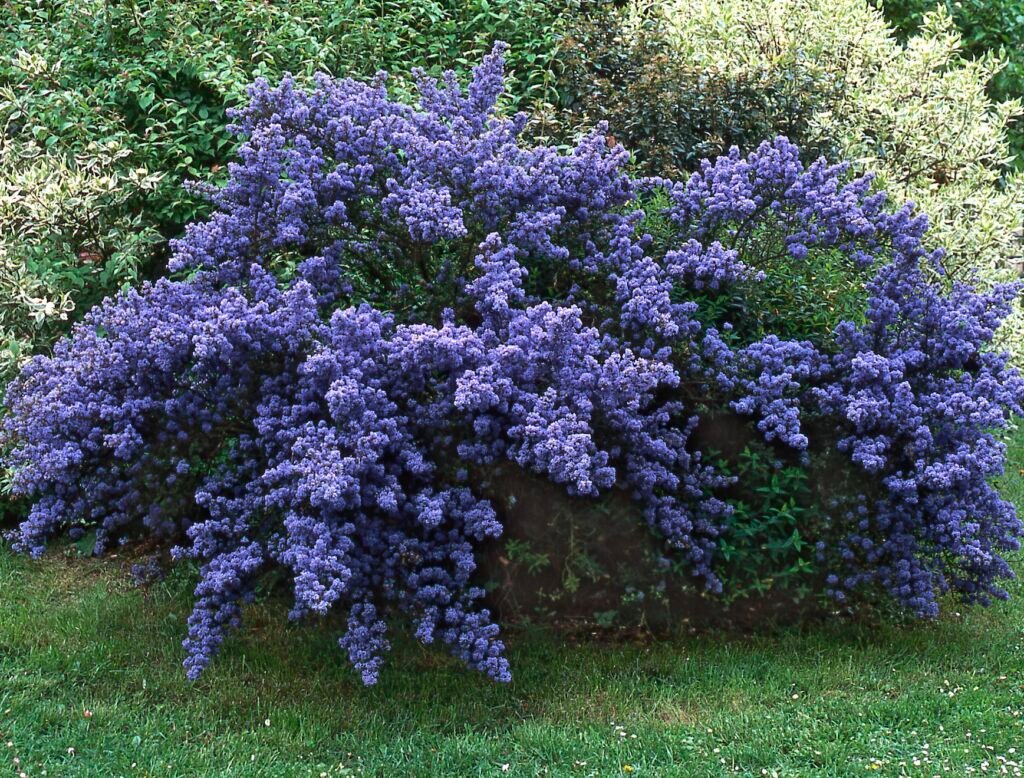
It is a dreamy indigo-blue cloud of large, dense clusters of tiny, fragrant flowers set against shiny dark foliage. Hazy and ephemeral, it is like an Impressionist painting—a result of the stamens peeking out beyond the flower petals, which is an adaptive strategy to increase the chance of their pollen sticking to a passing pollinator. Come July, the indigo-blue cloud fades away as it rains petals to the ground. The delicate petals rapidly shrivel up to brown dust and become part of the soil. No trace of blue. No honeyed scent. Maybe the floral cloud is simply an illusion—another California dream in our temperate tropical rainforest.
It is commonly called a lilac, not because it belongs to the same family as the true lilac (Oleaceae; Syringa), but likely due to the similar “bottlebrush” or “cone” shape of the flower clusters. When many tiny flowers group together, they create a beacon-like structure that increases visibility even from a distance. A siren scent and sight pollinators find irresistible.
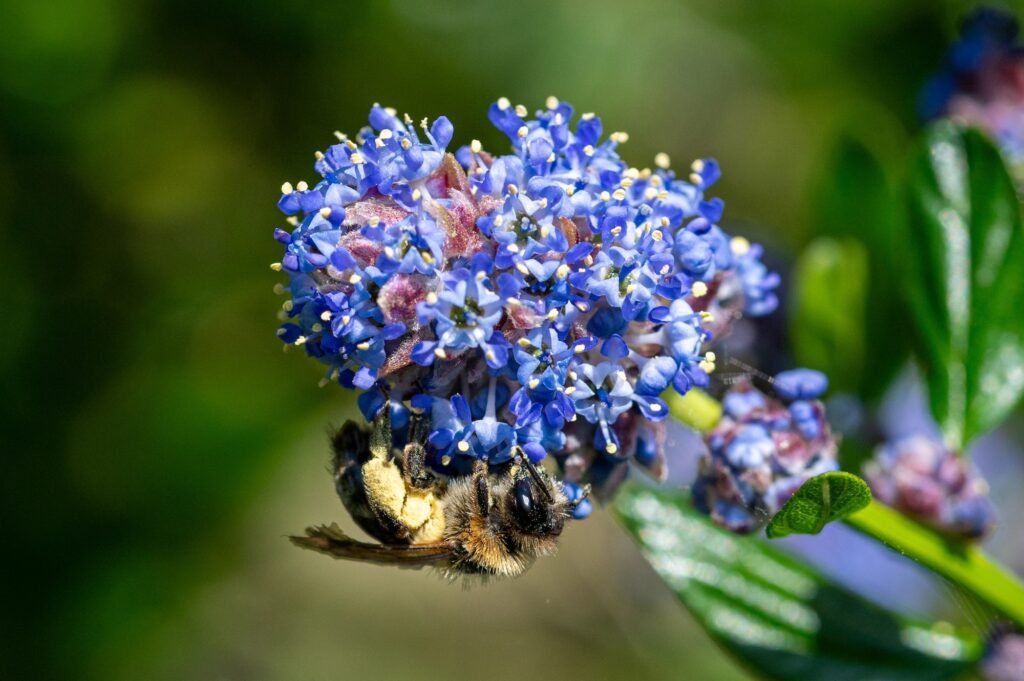
It’s a remarkable piece of biological engineering, really. A 360-degree buffet that balances surface area, resource management, and structural physics. Pollinators land from every direction, and because the flowers are spread around the circumference of the cone, each pollinator has plenty of personal space while they feed. This is a one-stop feeding station, so there is no need to waste energy flying to another shrub or flower stalk. The next flower is simply a crawl away. The cone shape also provides structural integrity to the many flowers it supports: the tapered form with a wide base, makes it sturdy, reducing the chance of snapping—especially with the added weight of rain, pollinators, or a careless hand.
I want one. No, I want eight of them planted in a gentle arc to mirror the curved corner of the lot, a feature garden bed. A pause like the red stop sign for humans in their vehicles at the very same corner, only this one will be functional and beautiful.
California lilacs sit on the edge of hardiness in growing zones 7 to 8—after all, California is the primary centre of the genus’ diversity. I am gardening in zone 8b, located about 100 metres above sea level facing the Burrard Inlet, but I soon discover that a Westridge garden often has pockets of microclimates ranging from 7b to 9a, depending on terrain and the amount of wind exposure. So to plant a row of California lilacs in that particular south-facing corner, mid-slope—wonderful with its full sun exposure—also exposes them to the wild elements with no protection. Mass planting can have a massive impact, for better or for worse, as I soon discover.
“Ride or die, baby,” I muttered in fevered shivers of blind infatuation, with the brown thumbs of a novice gardener.
So I purchase eight shrubs during a fall sale at the local nursery. After learning that California lilacs require good drainage, I haul bags of sand into the area and amend the soil before planting them. Exhausted and full of hope, I hold my breath. This winter is an unusually cold one. The young, newly planted shrubs exhale, succumb to the cold, and with their death, so dies my California dream. Shamefaced, I lug the eight carcasses to the nursery the next spring. With a receipt in a trembling hand, I evoke the “Green Thumb Guarantee” policy of the store, and the Eight-Dead are replaced with eight young, eager California lilac shrubs (you’d think I’d learn!). I am determined to try again (points for determination; penalty for stubbornness!). This time, luck is on my side, and perhaps planting them in the spring will give them a head start for the upcoming cold. The Gen-2 shrubs make it through their first winter, then their second, and soon they establish themselves in the corner of the lot, drawing bees and two-legged mammals at the height of their blooming season in June.
2015: The Death of a Mystery Rhododendron Shrub
As you boulevard west of the California lilac shrubs, if you pay close attention, you discover a secret path leading into the garden. The path is partially obscured by the natural form of the eighth California lilac shrub and its adjacent neighbour: a mature Rhododendron shrub, about eight feet tall, with light purple flowers in late spring. If you miss the secret entrance, a skip and a hop down the hill takes you to the main entrance marked by a sunshine-yellow climbing rose supported by a black metal arbor.
Now, the rhododendron shrub—a mystery one that came with the house—starts to drop its leaves. Eventually, it simply gives up the ghost, leaving a skeletal structure of trunk and branches like a fossil specimen.
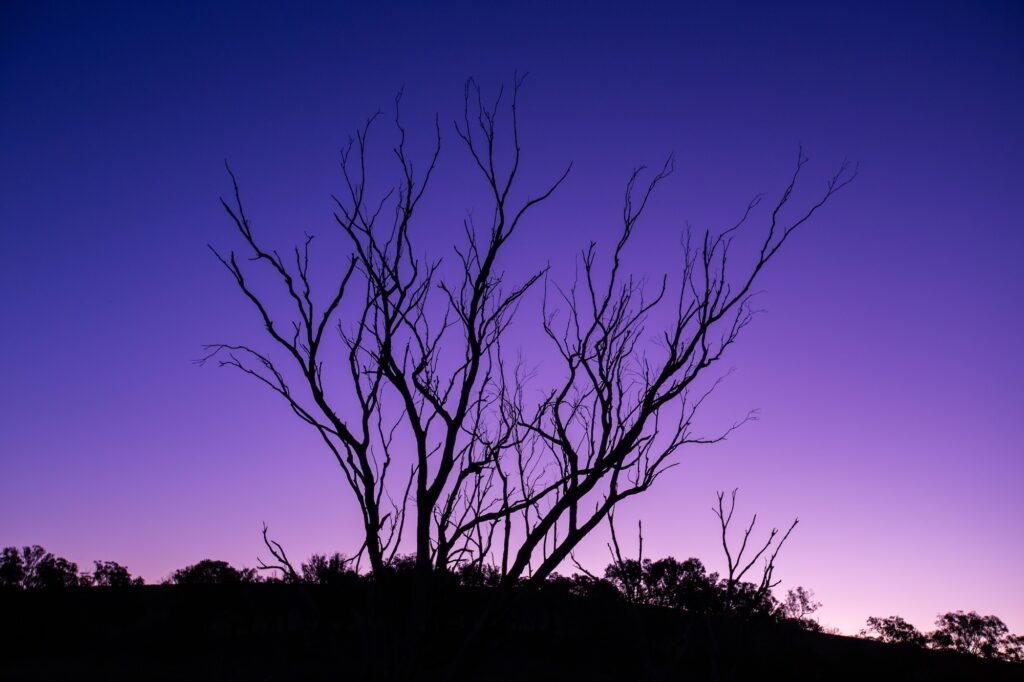
I half suspect that I am responsible for its death. Over the last decade, I’ve covered its root system with dug-up sod and spent soil from pots, and I’ve laid cardboard down at its feet to suppress weeds. Later, I learn that rhododendrons possess shallow roots and do not like to be buried deeply. Because of an endless list of garden tasks, I leave its carcass intact for some time. Crows start snapping off the dead twigs for nesting material; I even hang cat fur on the branches as nesting material for them. The dead shrub looks perfectly natural in the casual cottage garden. From time to time, when I cast a gaze in its direction, I reflect on the proverbial cycle of life and death—it is simply a change of state, a transformation. A neighbour offers to remove it, and I don’t know who is more mortified:
Me: “Why remove it?”
Neighbour: ‘Why keep it?”
It is time for me to add a small privacy screen to hide the “skeleton in the closet,” so to speak. So I buy three ordinary cedar hedges and plant them in front of the dead rhododendron shrub.
II. THE MIDDLE TALE (2015–2021):
2017: The Almost Living Wall with a Viewing Window
The three cedar hedges thicken nicely, and I am deciding how to shape them. How about a simple, tidy rectangle? How about a simple, tidy rectangle with a viewing window? Yes! So I trim the middle shrub down a foot or so. And as waiting is so often the case when growing a garden, I wait for the outer hedges to widen in order to shape a viewing window. I wish I had a photo to share here, but I don’t. So imagine a U-shaped form that starts to close in on itself, filling the empty middle. Then imagine hollowing it out in the middle to fashion a negative space in the shape of a rectangle.
2018: The Case of the Living Bookcase
And the waiting game continues. And my wandering mind wonders if there is a way to use the space, even as I wait for the hedges to fill in.
“How about a living bookcase?” whispers a passing cloud-thought.
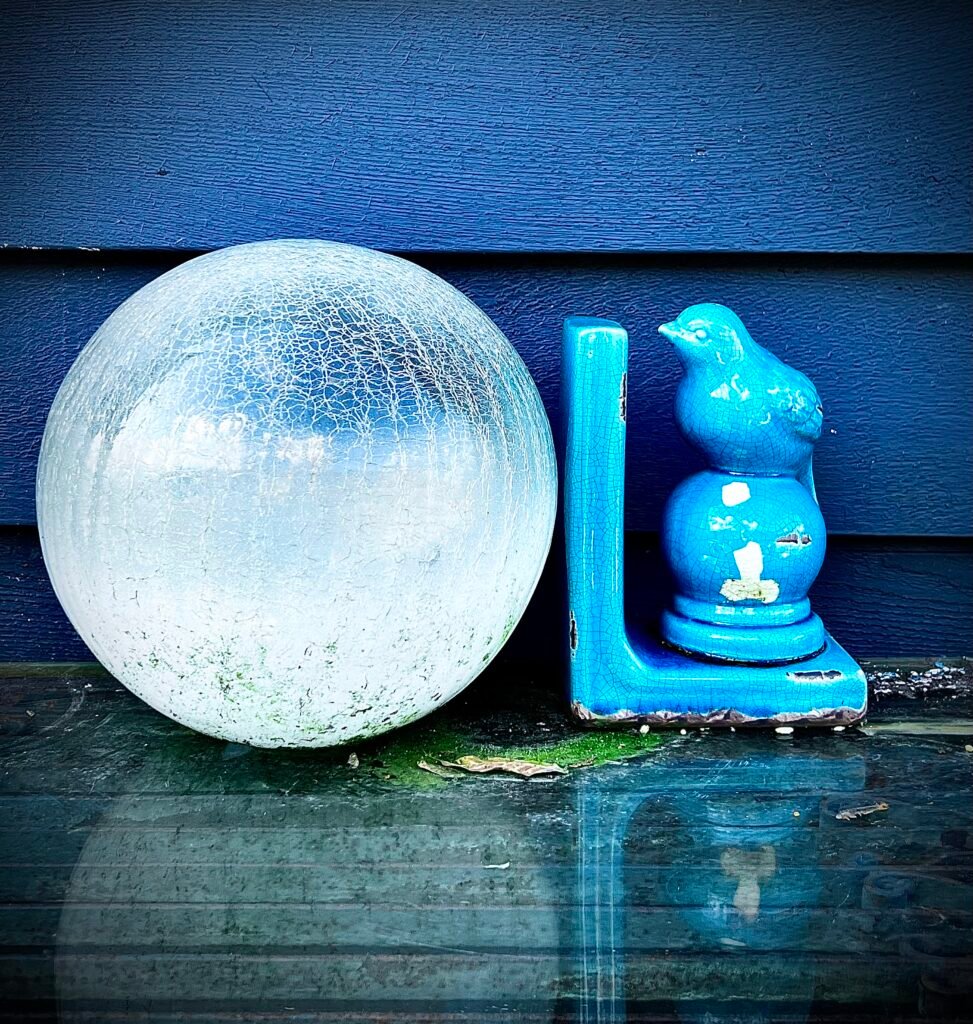
You see, I just scored two marked-down garden ornaments from HomeSense: a 10-inch crackle-glass gazing ball and a turquoise-blue ceramic bookend with a bird sculpture. I have yet to find a perfect spot for them. Since the middle hedge is trimmed about a foot or so, the woody centre is exposed, providing a sturdy foundation for a glass shelf about two feet long. After a few tests to ensure the shelf will hold, I place the gazing ball and bookend onto it. It is perfect—a wild idea that fits right into the wildlife garden.
2021: The Feline Face
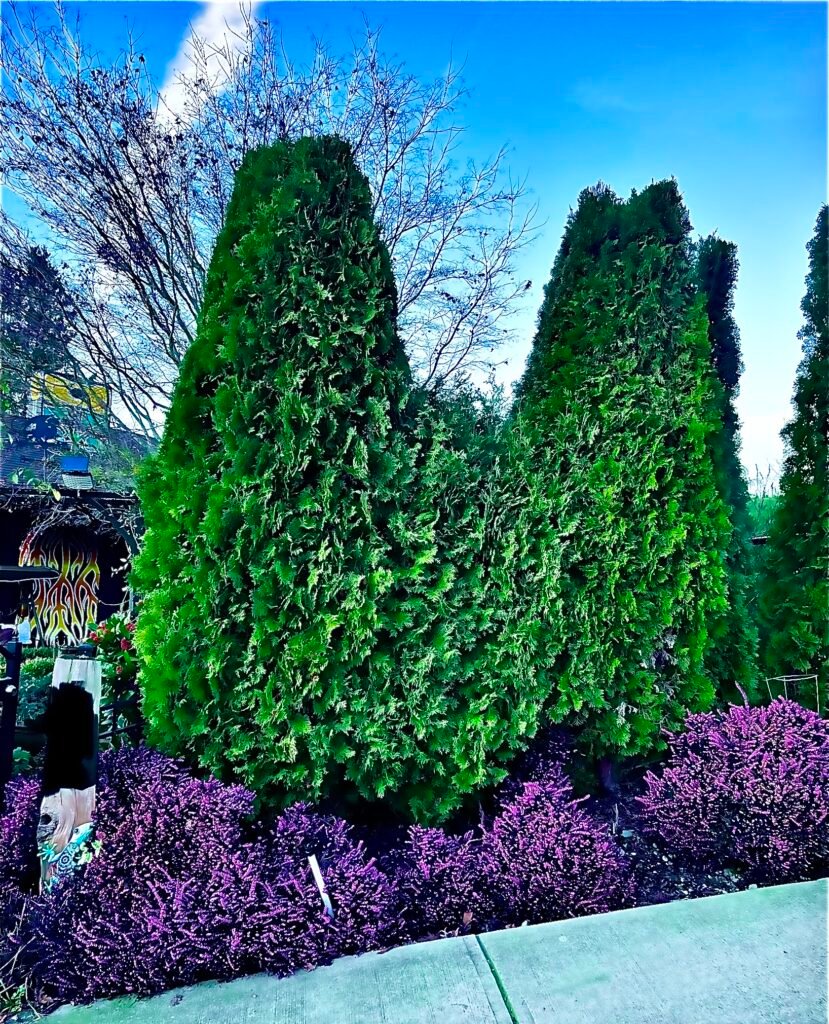
to sculpt the “Cheshire” grin.
Every winter, I remove the glass shelf, the gazing ball, and the ceramic bookend; every spring, I install The Living Bookcase. This spring, as I prepare to install The Living Bookcase, it suddenly strikes me—as wild ideas tend to do—that the form of the three hedges resembles the silhouette of a feline face. My inner child delights in the discovery. So, the waiting game continues, but this time, instead of a living wall with a viewing window, I wait for the face of a cat to fill in.
While this new wild idea takes seed, another is reaching the end of its journey.
2021: The Last Exhale of Another California Dream
Over the last few years, the Gen-2 California lilacs suffered winter burns and diebacks, and now they are standing on their last legs.
Live fast, die young–the motto of the California Lilac shrubs.
They no longer provide much privacy. So, with deep regrets, I remove them. Neighbours stop in their vehicles on the street to express their condolences and to tell me how much they enjoy the shrubs when they are in bloom.
I decide to use run-of-the-mill cedar hedges to continue the wall of established cedar hedges on the east perimeter of the lot, and perhaps, grow another California lilac in a mixed garden bed. I know the 18 new youngsters will never catch up with their established brethren, but they will serve a functional purpose as a privacy screen.
III. THE END THAT IS ALSO A BEGINNING
(2022 to Present):
2022: The 50-foot Cat—erpillar Topiary
One day, while working in the front garden, I look up at the cat face topiary, and my eyes drift left to the 18 unremarkable young cedar hedges. For the first time, my mind stitches them together to form a single entity.
“It’s a caterpillar,” I say out loud, in a matter-of-fact voice.
“And it’s a Cat—erpillar,” I say again. This time, my voice is coloured with wonder.
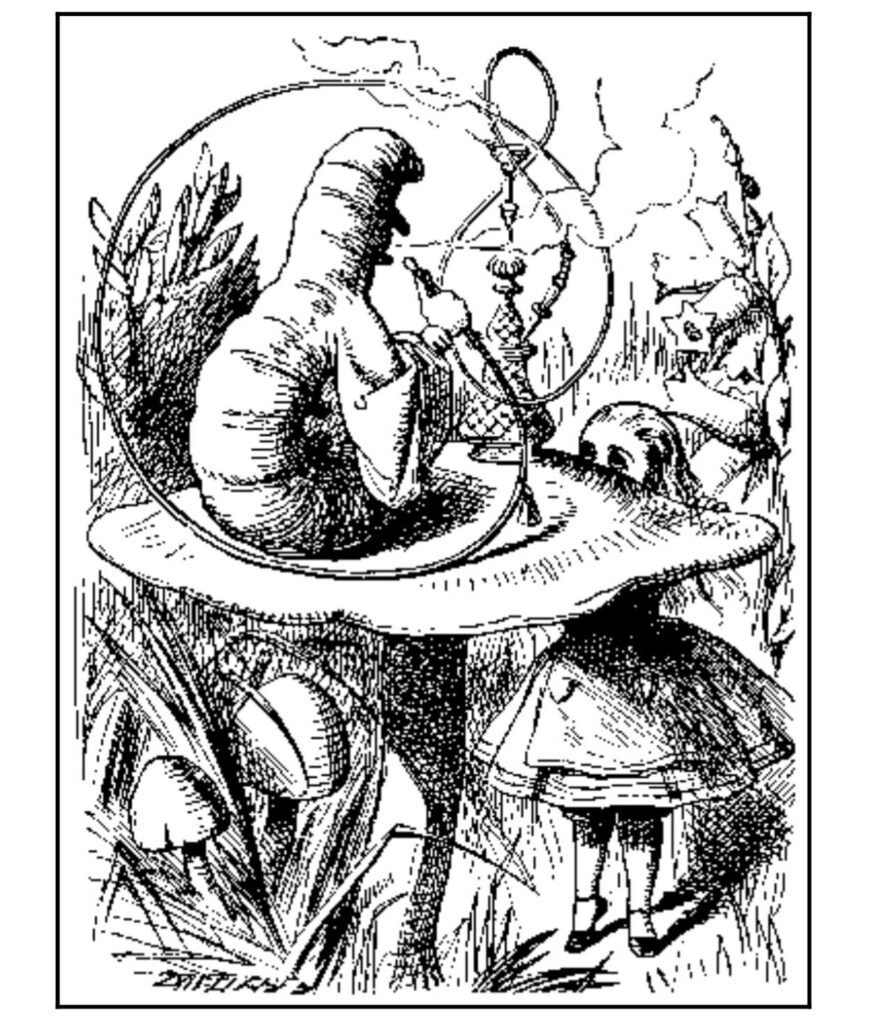
The body of the hookah-smoking caterpillar with the head of the Cheshire Cat in Alice’s Adventures in Wonderland. The thought continues like a disembodied voice in my head. My brain shapes a smile as wide as the Cheshire’s grin.
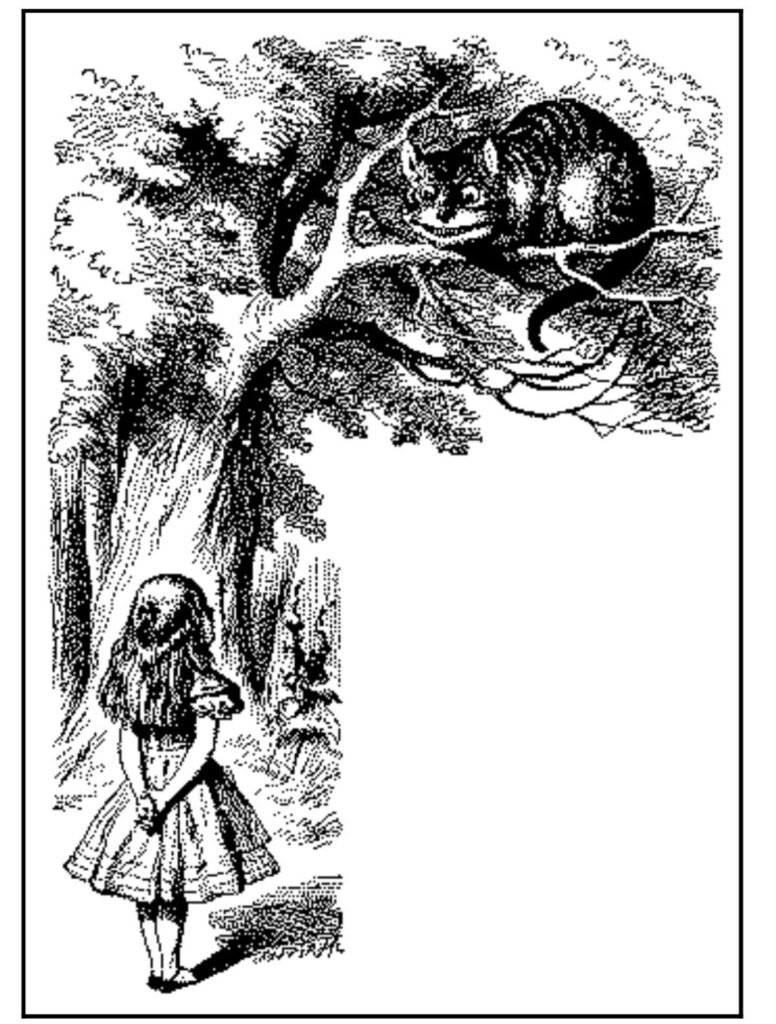
I am tickled pink, or blue like the caterpillar.
Fashioning a Cat—erpillar topiary solves the problem of the visually jarring difference in height and girth between the established cedar hedges and the newly installed ones.
{(3 cedars = head of a cat) + (18 cedars = body of a caterpillar)}
And so, this is the beginning of the Cat—erpillar story. It is more than a topiary; it is a linguistic and botanical mashup—a Matryoshka word and a chimera. It captures the curiosity of the Cheshire Cat and the wisdom of the Hookah-smoking Caterpillar. It is a 50-foot spine of ordinary cedar hedges that bridges the east perimeter with the arbor entrance. Its origin story—with roots planted over twenty years ago, much like the neighbourhood of Westridge itself, perched on the bedrock of Burnaby Mountain at the edge of the continent—is as unlikely as any Wonderland tale, a paradoxical evolution revealed only when one pauses to learn its history.

It has been a journey of seemingly unconnected shifts: from a row of California lilac shrubs to an almost living wall with a viewing window, then a living bookcase, a feline face, and finally, this 50-foot Cat—erpillar. The story is unlikely, and one only realizes how wonderful it is once the twenty-year path is uncovered.
Two decades is a significant chapter in a human life, but it is also a mere heartbeat in the deep time of this landscape, forged in the shifting rivers and basins of forty million years ago.